
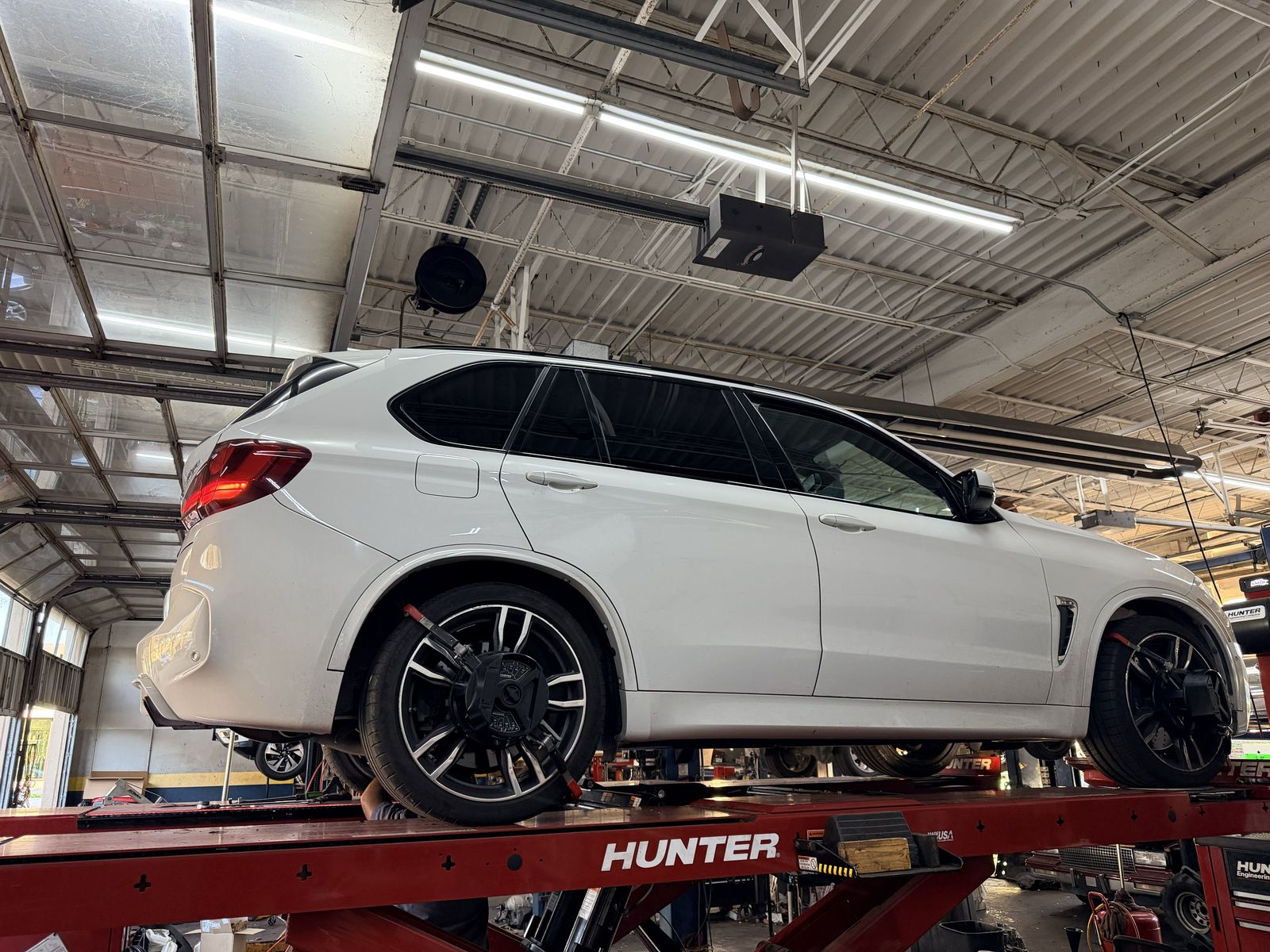
An alignment does not straighten anything. It sets three angles at each wheel so the tires roll flat, track straight, and return to center after a turn. Get them wrong and you burn through a set of tires in 15,000 miles and fight the wheel on every straight.
The three angles
Toe is whether the tires point slightly in or out, viewed from above. It is the angle that wears tires fastest. Camber is the tilt of the tire, viewed from the front; too much negative camber wears the inside edge. Caster is the steering-axis angle that gives you straight-line stability and self-centering.
When you need one
After new tires, after any suspension or steering part is replaced, after a hard pothole or curb strike (Cartwright Road has a few), or whenever the car pulls, the wheel is off-center, or the tires show edge wear. Annually is reasonable on Houston roads.
Why the equipment matters
We align on a Hunter system with camera targets on all four wheels. It measures to a hundredth of a degree, compares to the factory specification for your exact model and ride height, and prints a before-and-after sheet you keep. If a part is worn enough that the angle will not hold, the rack tells us — and we tell you before adjusting.
What it costs versus what it saves
A four-wheel alignment is a fraction of a set of performance tires. On a Cayenne or an X5 with staggered 21-inch wheels, that math is not close.
Questions about your car?
Call (281) 261-0400 or text (281) 761-4672. 1653 Cartwright Rd, Missouri City — Quail Valley Shopping Center.
Keep reading
The Check-Engine Light: What It Actually Means (and What It Doesn't)
A steady vs. flashing check-engine light, the most common causes we see in Missouri City, and why a parts-store code read is only the first step.
Read more →
Maintaining a European Car in Houston Heat: What the Factory Schedule Misses
Porsche, BMW, Mercedes and Audi service intervals assume mild climates. Here is what changes when your car lives at 98°F with 80% humidity.
Read more →